Business Plan

OpenAI previews business plan for ChatGPT, launches new privacy controls

OpenAI says that it plans to introduce a new subscription tier for ChatGPT, its viral AI-powered chatbot, tailored to the needs of enterprise customers.

Called ChatGPT Business, OpenAI describes the forthcoming offering as “for professionals who need more control over their data as well as enterprises seeking to manage their end users.”

“ChatGPT Business will follow our API’s data usage policies, which means that end users’ data won’t be used to train our models by default,” OpenAI wrote in a blog post published today. “We plan to make ChatGPT Business available in the coming months.”

OpenAI previously telegraphed that it was exploring additional paid plans for ChatGPT as the service quickly grows. (The first subscription tier, ChatGPT Plus, launched in February and is priced at $20 per month.) According to one source, ChatGPT is estimated to have reached 100 million monthly active users in January just two months after launch — making it the fastest — growing consumer applications in history.

Exploring potential new lines of revenue, OpenAI launched plug-ins for ChatGPT in March, which extended the bot’s functionality by granting it access to third-party knowledge sources and databases, including the web.

Despite controversy and several bans, ChatGPT has proven to be a publicity win for OpenAI, attracting major media attention and spawning countless memes on social media. But it’s a pricey service to run. According to OpenAI co-founder and CEO Sam Altman, ChatGPT’s operating expenses are “eye-watering,” amounting to a few cents per chat in total compute costs.

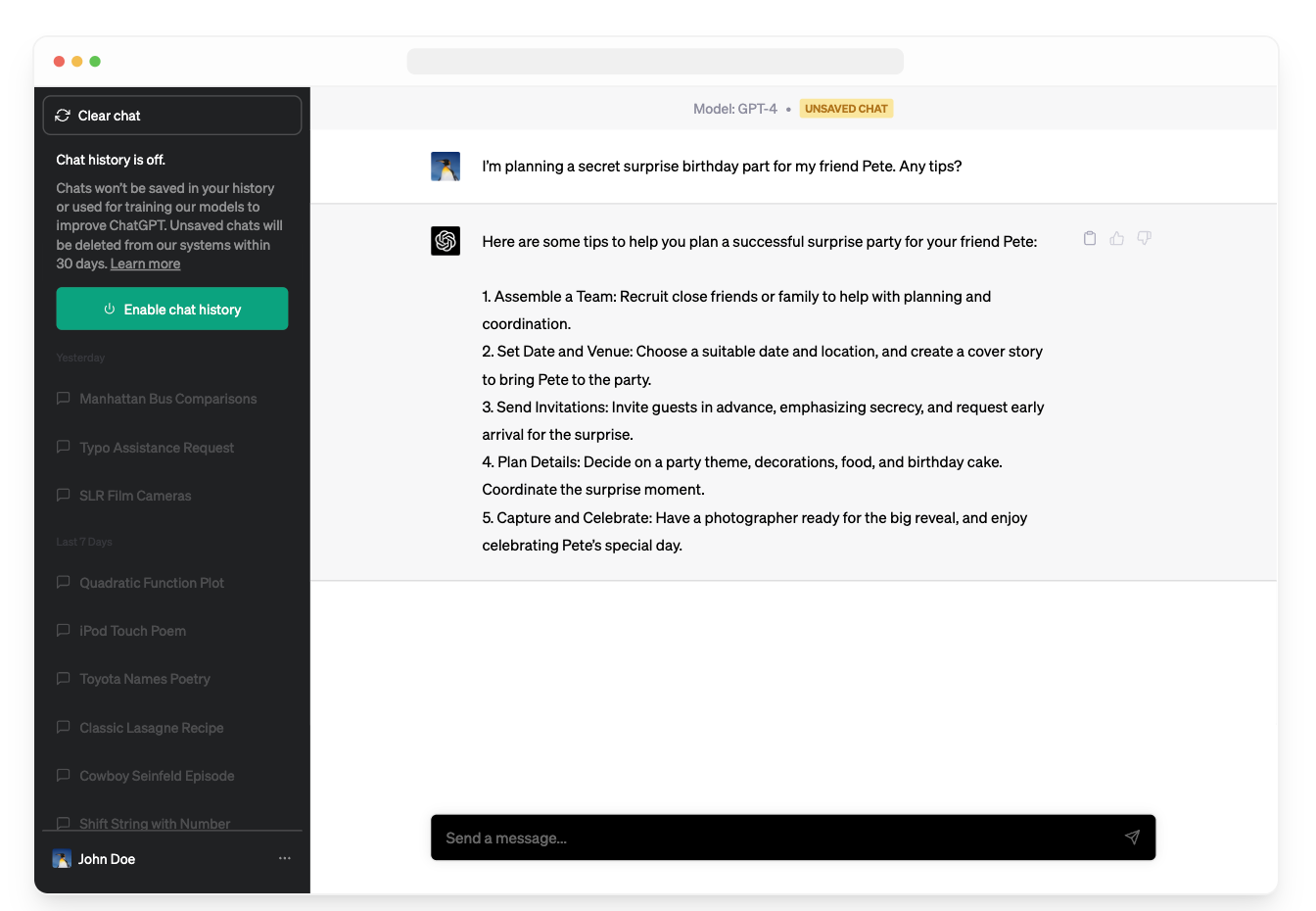
Beyond ChatGPT Business, OpenAI announced today a new feature that allows all ChatGPT users to turn off chat history. Conversations started when chat history is disabled won’t be used to train and improve OpenAI’s models and won’t appear in the history sidebar, OpenAI says. But they will be retained for 30 days and reviewed “when needed to monitor for abuse.”
OpenAI

New privacy features have arrived for ChatGPT users — perhaps aimed at allaying regulators’ fears. Image Credits: OpenAI

ChatGPT data can also be exported as of today. Users can request that their data be sent in a file to the email address associated with their OpenAI account.

The new capabilities come as regulatory scrutiny grows over OpenAI’s data practices. Italy last month banned ChatGPT for possible privacy violations, alleging that OpenAI unlawfully processed people’s data and failed to implement a system to prevent minors from accessing ChatGPT. France, Spain and Germany have also begun probing OpenAI and its commercial services, focusing on ChatGPT’s GDPR adherence.


Business, office and economy | ontario. ca

Building the economy

We are building the economy of the future to benefit you today. We’re investing in and connecting our electric vehicle (EV) and EV battery supply chains to create good-paying jobs across the province. EVs and the batteries that power them will be built in Ontario, by Ontario workers.

Unlocking critical minerals and the Ring of Fire

We’re unlocking the economic potential of the Ring of Fire and Ontario’s abundant supply of the critical minerals in the North to produce batteries for electric vehicles.

Training Ontario’s skilled workforce

We’re investing more than $1 billion to train the skilled workforce needed to build Ontario’s economy.

Made-in-Ontario electric vehicles and batteries

We’re connecting mines and minerals from the North with automotive and electric vehicle battery manufacturing in Southern Ontario so that communities across the province benefit.

Ontario’s clean competitive advantage

Invest in clean, green steel

We’re investing in clean steel to enhance our competitive advantage and help meet the demand for low-emissions manufacturing.

Securing Ontario’s clean-energy advantage

The future of our economy will be powered by clean, affordable, made-in-Ontario energy.

Projects and investments

Ontario is securing EV and EV battery investments that are creating and keeping good jobs in communities across the province. Data from October 2020 to March 2023.

17.5 billion

Total investments

13,700

Jobs created and retained

Find more information about our latest announced projects and investments.

Invest in Ontario

Learn how to join a growing number of businesses choosing Ontario .

Start and run a business

Start a business

Learn how to:

  • choose your business structure
  • register your business name in Ontario
  • set up an Ontario business number for business tax purposes

Get started

Get a custom guide

Answer a few simple questions and get a downloadable custom guide to start your business. For example:

  • business registration
  • getting an HST number
  • setting up payroll and benefits
  • permits, licensing and insurance

Take our questionnaire

Funding opportunities

Ontario has a number of funds available for entrepreneurs. Depending on the type of business you want to run, you may be eligible for programs and funding:

View a full list of funding opportunities.


Programs by region

Get support to expand or bring business to your community:


Permits and licenses

Find out what permits and licenses are required for your business, based on your location, industry and business activities.

Insurance

Workplace insurance

Find out if you need insurance for wage-loss benefits, medical coverage and support after a work-related injury or illness.

Business insurance

Protect against loss or damage to physical property, or the loss of your business’s ability to operate and generate income.

Workplace rules and regulations

Understand your obligations as a business owner, and the rights and responsibilities of employers and employees in Ontario.

Employment Standards Act

Learn the rules about minimum wage, hours of work limits, termination of employment, job-protected leaves of absence and more.

Occupational Health and Safety Act

Before starting specialized work (work that involves a trench, diving, window cleaning, tunneling and asbestos removal), you must file a work notice to protect the health and safety of your workers.

Learn everyone’s rights and duties in the workplace, and how to deal with workplace hazards.

Accessibility laws

Laws and standards are in place to make Ontario more inclusive for everyone.

taxes

In order to file business taxes and deduct payroll, you need a Business Number (BN). If you don’t have one already, learn how you can get a Business Number .

Harmonized Sales Tax

Learn more about the Harmonized Sales Tax (HST), see what items are subject to a point-of-sale rebate, and claim a rebate.

File taxes for free

Manage your tax account, returns, payments, and refunds for free online at ONT-TAXS.


Export and trade

Grow your business by selling products outside Ontario and Canada.

Events

Search upcoming international trade programs and events by sector and market region. Find trade missions, exhibitions, seminars, and workshops for Ontario businesses looking to export outside Canada.

Resources

Explore resources to help grow your exporting business such as market research, funding support, and insurance.

Indigenous resources

Get support

Close a business

Learn about how to close a business including succession planning, selling a business, closing accounts, and declaring bankruptcy.

Investment needs

Talk to a business consultant at Invest Ontario for your investment needs.

Join the “Ontario Made” program

Register as a manufacturer or retailer with Ontario Made . You’ll be listed in their business directory and get access to promotional materials, such as the “Ontario Made” logo.

Find a Small Business Enterprise Center near you

They provide advisory services and workshops that equip businesses with foundational entrepreneurship skills and continue support, including training, mentorship and grant opportunities.

See a full list of locations.

Help us better serve entrepreneurs and businesses

We value your feedback. Please take 2 minutes to let us know how we can improve our business and service information to best support you.

Fish-processing business plan set to go before minister – The Royal Gazette

Created: May 11, 2023 07:39 AM

Making progress: Erica Smith, the executive director of the Bermuda Economic Development Corporation (File photograph)

A fish-processing plant has moved a step closer to reality with the completion of a business plan for the project.

The plant is one of six infrastructure projects developed by the Government as part of its Economic Recovery Plan, launched two years ago.

The scheme is being spearheaded by the Bermuda Economic Development Corporation.

Erica Smith, the BEDC’s executive director, confirmed that a business plan was expected to be forwarded to the Government this week.

Ms Smith said: “We have completed the plan. It has recently been reviewed by BEDC’s board and recommended next steps have been agreed by the board.

“We are preparing the information to send to our minister for his consideration. That should be forwarded by the second week in May.”

According to the Government’s website, a shoreside facility will process fish caught off Bermuda. Under the plan, the Government will also support the purchase of ships to increase the domestic capture of fish, which will reduce imports and increase exports.

The website states: “Commercial fishing is one of the oldest industries in Bermuda and continues to be an essential part of Bermuda’s culture.

“However, its contribution to the economy has yet to grow proportionally to Bermuda’s population size or economic growth.

“The fisheries development center can be the catalyst that transforms the island’s artisanal commercial fishing industry to the next level.

“The center can make it profitable for all participants while improving the island’s food security by providing high-quality, sustainably harvested seafood from local resources, and diversifying the economy.

“The center will be able to offer several products and services for the industry, including those related to wholesale, retail, export, by-products and on-site experiences.”

5 Things You Must Know and Do Before Writing a Business Plan

Opinions expressed by Entrepreneur contributors are their own.

There are many articles about what to include in your business plan. But what about before you even start writing it? Are there things you need to know? Information you need to compile? Things to consider? You bet. Below you’ll learn five things you must know and do before sitting down to write your business plan:

1. Your business plan is a marketing document

The first thing you must understand before writing your business plan is that your plan is a marketing document. It is not a 50-page dossier explaining everything there is to know about your business. Rather, the document’s purpose is to convince others, such as investors, lenders, partners, employees, etc. to invest their time, money and/or resources in your company.

As such, your plan is a marketing document. It must compel readers to take the actions you want them to take. So, for example, rather than presenting a data dump in which you list every possible fact about your industry, focus on specifying the most relevant facts, and more importantly, discussing how those facts make your company even more likely to succeed.

Related: 7 Steps to a Perfectly Written Business Plan

2. Conduct market research

Before you start writing your business plan, you also need to conduct market research. This involves gathering information about potential customers, competitors and industry sizing and trends.

The purpose of this research is twofold: One, it helps you understand the competitive landscape in which you’ll be entering. Two, it helps you craft a sound and compelling strategy and properly position your company to readers as one that’s poised for success.

Much of the market research you need will be readily available. Look at industry associations or vertical websites that analyze your industry. For example, if looking for research for a business plan to launch a vending machine business, leverage sites like Vending Mavericks.

3. Figure out your precise use of funding

Most business plans are presented to funding sources such as banks, angel investors or venture capitalists in hopes of raising capital. One of the most important questions these funding sources will ask is how much funding you need and what it will be used for.

Before developing your plan, you need to get a firm grip on this answer. Doing so requires conducting market research. For example, if you plan to hire a new vice president of sales with the funding, research the annual salaries of such positions in your geographic area and/or market. Likewise, if your funding is to build out a restaurant, you need to talk with and get quotes from interior designers, contractors and equipment vendors among others so you have solid estimates of the costs you will encounter.

Related: The Essential Guide to Writing a Business Plan

4. Compile historical financials, and develop financial forecasts

If you’re writing a business plan for an existing business, you must compile all of your historical financial data. That includes past income statements and your current balance sheet.

For both existing and new businesses, your plan must also include financial projections. These projections include income statements, balance sheets and cash flow statements going five years out. Importantly, these projections must give investors and lenders the confidence that if they provide the funding you request, your business will be able to repay the funds (if a loan) from operating profits or gain tremendous value over time (if an equity investment) so the investors can sell their share at a significant profit later.

5. Determine how your business is uniquely qualified to succeed

Finally, you must determine how your business is uniquely qualified to succeed. This involves analyzing your competitive advantages and discussing how they will help you achieve success despite the challenges that may stand in your way.

For example, if you are entering a crowded market with dozens of competitors, discuss what makes your company’s product or service different from theirs and why that’s important. Or if you have a long-standing relationship with an established partner or customer, discuss what that means for your business and how it will help you secure additional resources, customers or profits going forward. Likewise, you may be uniquely qualified to succeed based on the intellectual property you have or the quality employees you have hired.

Importantly, you must recognize that the most successful companies have unique success qualities. Think through every key aspect of your business, your team, products, services, marketing plan, operations, etc., and figure out what’s needed to be uniquely qualified to succeed in each of these areas.

Related: How to Prepare and Write the Perfect Business Plan for Your Company

Anyone can write a business plan. But writing a business plan that achieves your goals is much more challenging. Those goals may include raising funding, convincing a company to partner with you or developing a solid roadmap for success among others. In any case, knowing and doing the five things mentioned above will allow you to create a winning business plan and achieve lasting success.

BMA published 2023 business plan – The Royal Gazette

Created: Feb 03, 2023 07:41 AM

Agility and nimbleness: Craig Swan, chief executive officer of the Bermuda Monetary Authority (File photograph)

The island’s financial services regulator has set out its stall for the year ahead, with the release of its business plan for 2023.

The Bermuda Monetary Authority said the document is a blueprint, detailing how the BMA will continue to deliver its mandate, the progress it plans to make on its multiyear phased initiatives and the projects it will launch to maintain agility and nimbleness in its systems and processes and build on the strengths of Bermuda’s financial services regulatory and supervisory regime.

Highlights include:

• Further positioning its human resources to skillfully deal with the complexities of emerging infrastructures, products and technologies

• Strengthening the anti-money laundering/anti-terrorist financing supervisory data call approach, namely through further automation and data collection, analysis and presentation enhancements

• Formalizing the BMA’s internal environmental, social and governance approach and diversity, equity and inclusion programme.

The BMA said these initiatives fit alongside the ongoing work and multiyear priorities that the organization will carry into 2023 such as the continued buildout of the conduct of business regime and ESG standards across sectors; greater use of technology in supervision and operations; maintained commitment to supervising entities’ operational resilience; and enhancements to the regulatory framework, where necessary.

Craig Swan, BMA chief executive officer, said in a foreword: “The 2023 business plan is dedicated to converging innovation across the BMA’s building blocks of people and processes.

“The goals, objectives and initiatives we have set for ourselves this year bridge these aspects of our organization and will allow the BMA to find new and better pathways for enhancing a regime that fulfills our mission, vision and mandate.”

The BMA said it would publish a range of thematic, insurance-related thought leadership materials during the course of the year, including reports on alternative capital, captives, catastrophe risk in Bermuda, and cyber (operational resilience and cyber underwriting).

BMA Business Plan 2023

The Bermuda Monetary Authority has released its roadmap for the year ahead (File photograph)

Business Plan and Entrepreneurship Toolkit: Frameworks & Templates

Our Story

‘Imagine having a team of ex-McKinsey, Deloitte and BCG Management Consultants at your disposal at any time of the day to help you solve your business problems and improve the growth and efficiency of your organization. How much more confident would you be about the future performance of your organization and your own career progression? How much more time could you save?

If you have ever tried solving business problems that you haven’t encountered before, you know how frustrating it can be to start from scratch. And even then, you still aren’t sure if what you’re doing is going to end up wasting your time and money. Having someone by your side who has already solved these business problems would be a huge help. That’s why businesses hire management consultants for support in the first place.

The only problem is that hiring a couple of tier-1 Consultants for a management consulting project would cost you at least $300,000! Not every business or team can afford this.

I wanted to do something about this because I believe everyone deserves to receive high-value business guidance, regardless of their budget!

That’s why in 2012, I decided to team up with other ex-McKinsey, Deloitte and BCG Consultants to create all the Management Consulting Toolkits required to solve your business problems and improve the growth and efficiency of your organization!

Whether you’re an executive, entrepreneur or consultant from a small or large organization, you can now leverage the know-how and best practices of our ex-McKinsey, Deloitte & BCG Management Consultants without breaking your budget.’

SeABank successfully completed the business plan of 2022

HANOI, Vietnam, Feb. 3, 2023 /PRNewswire/ — Despite 2022’s unstable markets, SeABank (stock code: SSB) successfully maintained a stable growth and completed the business plan set out in 2022 with impressive profit-before-tax of nearly US$216.16 millioncompleting 104% of 2022’s profit plan thanks to proactive business solutions and risk management.

Notably, Total assets reached US$9.87 billion, increasing 9.34%; Return on assets (ROA) and Return on equity (ROE) were 1.83% and 18.1% respectively, showing SeABank’s top-tier efficiency; cost-to-income ratio (CIR) decreased to 35.3% and bad debt decreased to 1.60%.

Remarkably, net non-interest income (NOII) has impressively grown by 43%, reaching US$112.6 million and accounting for 12.7% of total revenue. This demonstrates SeABank’s stability and sustainability, which are further enhanced through product structure diversification; digital banking and non-credit activity development; effective utilization of existing customer profiles.

Moreover, SeABank has increased its charter capital to US$844.73 million in 2022. It is on track of reaching US$870.06 millionpartly with the implementation of the 2022 ESOP program that benefited more than 2,500 employees.

In 2022, SeABank continuously implements and applies international standards to banking operations. Typically, the Bank applied Basel III risk management standards and International Financial Reporting Standards (IFRS), received Ba3 ratings from Moody’s for many categories.

Simultaneously, SeABank expanded international cooperation and attracted valuable investments totaling up to US$500 million from DFC, IFC and other international investment funds. This improved SeABank’s financial capacity to support SMEs, especially women-owned ones, and green credit. It also diversifies with capital mobilization channels, thereby increasing low-cost capital to benefit customers.

“Digital convergence” strategy also enhanced SeABank’s competitive advantages. Particularly, the Bank has automated working processes through applications such as e-office (SeAOffice), FPT.AI virtual assistant, etc. Besides, SeABank applies the most updated technologies such as AI, cloud computing, etc. to build business-responsive applications and digitize products, services. This led to optimized costs and operating time, promoting convenience and experience for both customers and employees. As a result, SeABank reached an impressive e-bank user growth with 941,608 new users.

SeABank also keeps expanding its operating network, bringing the total number of transaction points to 180 across 31 regions nationwide. SeABank’s brand reputation and strong growth in 2022 are marked by various prestigious awards and honors: Vietnam National Brand 2022 (Ministry of Industry and Trade), “Top 1000 World Banks 2022” (The Banker), “Best Companies to Work for in Asia 2022″ (HR Asia), “Bank of the Year” (The Banker), etc.

SOURCE SeABank

Time to become Virtually perfect

Some might believe that the COVID ’19 pandemic was the harbinger of a heightened digital health wave, while others might believe that the pandemic simply hastened the process of its evolution and adoption. I, for one, stand by the latter. The Digital Health market size was around US$ 195.1 billion in 2021, and is estimated to substantially grow to around US$ 780.05 billion by 2030¹. The spending on digital healthcare solutions is estimated to reach US$ 244 billion by 2025². Digital Health companies have been slowly simmering, brewing, adapting and growing, and have seized the market when the time was ripe.

When the pandemic necessitated the need for mitigation amidst disruption and chaos, Health Technology companies were ready to offer mature plug and play solutions that made adoption seamless and imperative. Furthermore, several countries quickly recognized the need to alter privacy policies and data protection regulations to enable remote consultations and virtual health interventions³. This was propelled by the paucity of physical resources, and coupled with an alarming need for accessible, quality healthcare. But more importantly, there was a stark realization and label for a new type of care delivery that need not be in-person- virtually, virtual.

Objectively, virtual care could be segmented into care that makes you get better, and care that makes you stay better…alternatively, curative and preventive. While the former milked patient care during the need of the hour, the latter emerged a new, unsung hero; An unexploited solution to a global, age-old opportunity. Center for Medicare/Medicaid Services’ (CMS) intent to incentivize increased and improved care management could/can take swift flight upon the wings of software platforms like that of HealthViewX. Solutions like Remote Physiological Monitoring (RPM), Transitional Care Management (TCM), Chronic Care Management (CCM), among others, help care teams monitor, manage, and engage patients right from their homes. This in turn has shown to reduce costs and readmissions, mitigate risks, improve outcomes and increase reimbursement⁴. A win-win-win!?

But, hold on! While all this sounds rosy and convenient, I have wondered whether there has/had been resistance in adoption amongst clinicians and patients…the end-users, ultimately. I stumbled upon an informative adapted strategy matrix in an article by Ande De. In a matrix outlining the degree of change behavior needed from clinicians, versus the degree of patients’ resistance to adopting new technology, TeleHealth, RPM and COVID screening, response and monitoring, emerged the most victorious with the least resistance from both stakeholders⁴. While cloud based web portals and health applications that record patient data were met with some resistance, it was a pleasant surprise to note that there were no digital health ‘failures,’ that were met with high resistance⁴. The data also shows that Artificial Intelligence (AI), Prescriptive and Predictive Analytics are here for the ‘long haul,’ being met with high resistance amongst clinicians and low resistance amongst patients⁴…all predictable, yet surprising at the same time!

While there could be several intuitive, understandable reasons for resistance, I’m compelled to boil it down to,

  1. Change Management:

    Willingness to embrace change and make the time to familiarize with change. Technological evolution brings up several unknowns, mostly in terms of whom to involve, when and how. While internally developed digital health infrastructure might make these unknowns less gloomy, it is unlikely that health systems have the time, resources and bandwidth to constantly troubleshoot and upgrade. While this drawback is moot with third-party digital health vendors, challenges arise with seamless interoperability, integration and complete customization to the needs of the organization.
    Encouragingly, a growing number of companies like HealthViewX are attempting to address these issues at the grassroots level. The platform entails seamless integration with a home grown interoperability engine, and the ability to completely customize the platform.

  2. Liabilities:

    Fear of and risks associated with the unknown. Several clinicians may not be sufficiently trained in using digital tools, alongside issues with seamless integrations… resulting in potential medical malpractices and associated legal claims. There are several open-ended concerns- are these malpractice claims attributed to the clinician, to the technology, or to those responsible for training⁵? Is there a clear, established, legal norm/protocol for how care via digital tools needs to be rendered and documented⁵? Most importantly, is confidential patient data safe and secure?
    In a survey conducted amongst 242 clinicians in Pakistan, 69% ‘agreed’ or ‘strongly agreed’ with the sentiment that there is a lack of regulation to avoid medical malpractice. Only 29% believed that their medical indemnity would cover telehealth consultations. Another study discovered that clinicians were less confident about prescribing controlled medications via TeleHealth.
    On the other side of the coin, studies have shown that several malpractices, misdiagnosis or errors could have been avoided with the intervention of AI and digital health. This is with the help of real-time alerts, diagnostic decision support, tracking, reporting, etc. Increasingly, laws have been restructured to exonerate AI/digital health in the face of mishaps, under several circumstances.

  3. Proofs:

    A natural barrier to adoption in general is a lack of evidence based outcomes. The advent of Digital Health solutions might not be mature enough to present a historic laundry list of troubleshooting and adaptability to the constantly evolving needs of users. However, the more external digital health solutions are adopted by health entities, the more their counterparts have a track record to witness and to pine for.
    A valuable metric rests in the achievement of the Quadruple Aim, ie, focusing on Population Health, enhancing the experiences of end-users, and of care providers/clinical staff, and reducing the per-capita cost of health care⁶. There are several intangible outcomes such as, provider burnout, time saved, patient outcomes, and patient satisfaction. Externally developed tools also often provide case studies or scientific evidence displaying them meaningful outcomes.

  4. Access:

    While digital health has redefined care with a click of a button, socio-demographic barriers to access could result in health disparities and a digital divide. This could be segregated into a technological barrier (such as, lack of smart devices and internet connection, the prevalence of digital health in their region/community) and, a digital literacy barrier involving the ease of use of technology depending on age, literacy, income and tech-savvyness, etc.
    While the digital divide can be narrowed by subsidizing the inherent cost of access, and perhaps by installing public access kiosks, ultimately, the utopian vision should be to extend beyond digital literacy to digital mastery and autonomy⁷.

My presumptuous, yet sagacious retort to these four points is, time.

Time to be moved. Time to take the plunge. Time to embrace. Time to get and assess outcomes. Time to advance. Time to revolutionize.

Time to become Virtually perfect.

References:

  1. “Digital Health Market Size Will Attain USD 780.05 Billion by 2030 Growing at 16.1% CAGR – Exclusive Report by Facts & Factors,” February 2023, Facts and Factors, https://www.globenewswire.com/en/news-release/2023/02/01/2599148/0/en/Digital-Health-Market-Size-Will-Attain-USD-780-05-Billion-by- 2030-Growing-at-16-1-CAGR-Exclusive-Report-by-Facts-Factors.html
  2. “The Use of Digital Healthcare Platforms During the COVID-19 Pandemic: the Consumer Perspective,” Alharbi. F, March 2021, PMC, https://www.ncbi.nlm.nih.gov/pmc/articles/PMC8116074/
  3. “Digital health and care in pandemic times: impact of COVID-19,” Peek. N, Susan. M, Scott. P, 2020, BMJ Journals, https://informatics.bmj.com/content/27/1/e100166
  4. Degree of adoption diagram, “Five ways Digital Health Innovation will grow + evolve post pandemic,” Ande De, April 2020, Alteryx, https://www.alteryx.com/input/blog/5-ways-digital-health-innovation-will-grow-evolve-post-pandemic
  5. Digital health technology-specific risks for medical malpractice liability” S. Rowland, E. Fitzgerald, et al, October 2022, https://www.nature.com/articles/s41746-022-00698-3
  6. “Assessing the impact of digital transformation of health services,” EXPERT PANEL ON EFFECTIVE WAYS OF INVESTING IN HEALTH , Barros, P et al, November 2018, https://health.ec.europa.eu/system/files/2019-11/022_digitaltransformation_en_0.pdf
  7. The Digital Determinants Of Health: How To Narrow The Gap,” K. VIgilante, Feb 2023, https://www.forbes.com/sites/forbestechcouncil/2023/02/02/the-digital-determinants-of-health-how-to-narrow-the-gap/?sh=384def8c59ba